
• Who We Are
    • Our Mission
    • Meet Our Staff
    • Meet Our Board
    • The Alaska Center Education Fund
  • Our Programs
    • Electing Leaders
      • Endorsements
    • Climate & Clean Energy
      • Clean Energy Stories
    • Salmon & Clean Water
  • Stay Connected
    • Hot Takes in a Cold Place
    • Become a Volunteer
    • Email Sign Up
    • Events
    • Careers
    • Ways to Give
    • Contact Us
  • Donate
  • Menu Menu

The always changing moods of Juneau

March 3, 2023/in Blog, Clean Energy, Democracy, Legislative Session

[cs_content][cs_element_section _id=”1″ ][cs_element_layout_row _id=”2″ ][cs_element_layout_column _id=”3″ ][cs_element_text _id=”4″ ][cs_content_seo]Greetings from Juneau – It was calm and clear when we arrived by night, sunny the next morning, then a front moved in the next day with wind and light snow that swept off the eves in great somber flags. By evening this had turned to rain, and the snow removal equipment was busy moving sloppy snow around the streets. Two-wheel drive cars performed their usual icecapade dances down the steep streets near the capitol, veering, sliding, and spinning out.
The talk in the capital this week was at first on education funding, and then the Senate Majority released their plan to bring back a defined benefit pension program for new and existing state workers. There was a rally for gun safety legislation on the capitol steps. No gun safety legislation has been filed, and few legislators want to make it an issue this year, though a red flag law bill was introduced last year. Education funding and the pension plan will remain the foundation of discussion and negotiation throughout the session and likely into next year. The new House Republican Majority – with many members holding gavels for the first time in their legislative careers – has been likened to a group of people out on the open ocean building a ship as they go along, much less supplying it with provisions or charting a course.
By the numbers – with moderate Bush Caucus Democrats and Independents and a moderate Republican or two in the House Majority combined with the House Democratic minority and the Bi-partisan Super Majority in the Senate, the votes are there to pass some form of pension reform and provide a much-needed boost to our education system’s funding. The committee chairmanship in the House is what greatly complicates the equation. The chairs of the House Education, House State Affairs, and other key standing committees wield power to stop these efforts in their tracks, consigning them to the graveyard of bills or holding them as a ransom for whatever far-right policy is on the caucus wish list. That there is a huge problem because the House Majority has not articulated a vision or a policy platform of any coherency, so it is hard to tell what end-of-session horse-trading might look like.
We are here mainly to talk about our democracy platform – opposition to the repeal of Ranked Choice Voting (RCV) and support for broad omnibus elections bills that include ballot curing and postage paid by mail envelopes. We have met with numerous Senators, Representatives, Staffers, Communications folks, Lobbyists, and Passers-By and have not heard from anyone that the bills seeking to repeal RCV stand a chance. We expect some traction this year on SB 19, elections legislation sponsored by Senator Kawasaki. We bet that SB 19 will pass this year from the Senate to the House. In the House, the bill has to go through the House State Affairs and the House Judiciary committees and Judiciary is chaired by Rep. Vance, who is an election denier, sponsor of an RCV repeal bill, and generally not a lawmaker you want within a hundred yards of any election policy discussion.
We also circled back from our previous visit with lawmakers regarding our clean energy priorities, including a Renewable Portfolio Standard, a state Green Bank, the extension of the Renewable Energy Fund, and legislation to grow Community Solar installations (or Gardens, as we prefer to call them) in Alaska. Good News Flash! We expect a Community Solar bill to be introduced very, very, very soon, and the House and Senate bills to extend the Renewable Energy fund are hurrying through the process like formula one race cars. Both are idling now in their respective Finance committees, the last pit-stop until passage.
We will update you next week when the vibe and the weather have changed a hundred times over.
As always,
The Alaska Center

\n\n[/cs_content_seo][cs_element_gap _id=”5″ ][/cs_element_layout_column][/cs_element_layout_row][cs_element_layout_row _id=”6″ ][cs_element_layout_column _id=”7″ ][cs_element_button _id=”8″ ][cs_content_seo]Bills To Watch\n\n[/cs_content_seo][/cs_element_layout_column][cs_element_layout_column _id=”9″ ][cs_element_button _id=”10″ ][cs_content_seo]More Hot Takes In A Cold Place\n\n[/cs_content_seo][/cs_element_layout_column][/cs_element_layout_row][/cs_element_section][/cs_content]

https://akcenter.org/wp-content/uploads/2023/03/Hot-Takes-Banner-2.png 400 1200 Megan Kelley https://akcenter.org/wp-content/uploads/2025/02/the-alaska-center-with-tag.svg Megan Kelley2023-03-03 23:01:552023-03-03 23:01:55The always changing moods of Juneau

Do Your Damnedest, and Fight

February 24, 2023/in Blog, Clean Energy, Climate, Democracy, Leg with Louie

With Representative David Eastman grabbing headlines as he is prone to through his outrageous, racist, stupid, dull, and performative statements, and with Senator Murkowski offering the sobering reminder that our great state is losing population like a deflating balloon, it is tempting to fall into the trap of the February blahs.

Take heart! The fact that the whole State House unanimously and rapidly condemned Eastman’s latest statements on the deaths of violently abused children is a sign that we have not lost our collective sanity. The fact that Education funding is top of mind with many lawmakers is a sign that we have an eye on the state’s future. The fact that a multipartisan caucus of first-year lawmakers has formed in the House and a mega-gigantic super bipartisan majority has formed in the Senate is important.

We have seen food security, bycatch reduction, and renewable energy become more than just vague talking points on the lips of our politicians over the past few years. We have seen our federal delegation come together to support broad infrastructure legislation. We have a new marine highway vessel in the works. The Pebble Mine has been set back significantly by the Environmental Protection Agency. Juneteenth and Indigenous Peoples Day have just been added as Anchorage Municipal holidays. Things are looking up (perhaps we caught the eddy in the metaphorical climate change river rushing towards floods, searing heat waves, drought, pestilence, and swarms of insects).

Now is not the time to give up.

In the immortal lines of poet Robert Service, “You’re sick of the game!” Well, now, that’s a shame. You’re young, and you’re brave, and you’re bright. “You’ve had a raw deal!” I know — but don’t squeal, Buck up, do your damnedest, and fight. It’s the plugging away that will win you the day, So don’t be a piker, old pard! Just draw on your grit; it’s so easy to quit: It’s the keeping-your-chin-up that’s hard.
We will be back in Juneau next week, meeting with lawmakers on our priority Democracy legislation. The specific bills we are supporting are SB 19 and HB 37, which would require the Alaska Division of Elections would to provide stamped return envelopes for absentee ballots, automatically check voters’ signatures, allow voters to fix their absentee ballot signature if there’s a problem, and create a ballot-tracking system viewable by the public. While the effort to repeal our Ranked Choice Voting/Open Primary law will go nowhere in the legislature (but will be a significant fight as a ballot proposition), bills to protect voters’ rights are in the hopper. These must move forward to ensure that all votes, and all voices, are heard in these critical elections that will help rebuild our state.

We will also circle back with lawmakers on our priority clean energy legislation: extension of the Renewable Energy Fund, creation of a Community Solar law, a Renewable Portfolio Standard, and a Green Bank for Alaska. The passage of these bills will help us create the Alaska we want to see for our children and grandchildren.

Thank you for your support,
The Alaska Center

https://akcenter.org/wp-content/uploads/2023/02/Hot-Takes-Banner.png 400 1200 Megan Kelley https://akcenter.org/wp-content/uploads/2025/02/the-alaska-center-with-tag.svg Megan Kelley2023-02-24 21:41:142025-01-06 05:24:08Do Your Damnedest, and Fight

In the shadow of the clean energy wave

February 18, 2023/in Blog, Clean Energy, Climate, Legislative Session

[cs_content][cs_element_section _id=”1″ ][cs_element_layout_row _id=”2″ ][cs_element_layout_column _id=”3″ ][cs_element_text _id=”4″ ][cs_content_seo]Since the passage of the federal Inflation Reduction Act (IRA) last summer, there has been a sense that a great tsunami is brewing, originating in Washington D.C. (at the Department of Treasury, Department of Energy, Environmental Protection Agency, and other solemn bureaucratic bunkers) rumbling and growing and about to sweep across the nation with transformational power.
In the interim between the passage of the act and the process of developing rules and programs to implement the IRA, skeptics have filled the void with dark muttering about the cost (while ignoring the cost of the Trump tax cuts and ignoring the cost of doing nothing on climate change) and the States, Local Governments, Tribes, Utilities, Nonprofits and others who will see the benefit have endured a vague worry that they are not doing enough to prepare, not hiring enough grant writers and researchers and/or creating programs that can receive federal funds.
We know the following is about to roll across the nation: $9 Billion in Home Energy Rebates, $1 Billion in Energy Code Assistance, $14 Billion in Clean Energy Business Loans, $ 9 Billion in Energy Grid upgrades, $1 Billion for Affordable Housing, $7 Billion for Clean Transportation, $277 Billion in Energy Tax Credits, $27 Billion for the Greenhouse Gas Reduction Fund, $3 Billion for Environmental Justice Block Grants, $12 Billion for Rural Energy Assistance, $2.6 Billion for Coastal Climate Resilience programs, and $7 Billion for various other clean energy initiatives. Soon programs associated with these pots of money will start to take shape, and that is when we will begin to see the impacts of this most historic investment.
On Feb. 14, the Environmental Protection Agency rolled out its plans for the $27 Billion Greenhouse Gas Reduction Fund with a goal to open up competitive funding rounds this summer for two separate programs – a General and Low Income Assistance competition and a Zero Emissions Technology Fund competition. Also recently, the Department of Energy created the Office of State and Community Energy Programs to implement programs flowing from the IRA and the previous Bipartisan Infrastructure Law.
Don’t expect to go to sleep in an unjust, carbon-belching world and wake up in an electric futurama where environmental equity is solved. The IRA is going to take time. Probably the benefit of many programs will not be fully realized before the next presidential election. While it is up to the Biden Administration to tell the story of the clean energy, clean transportation, clean jobs, and resilient infrastructure, the environmental justice in the IRA, the transformation spurred by the IRA will well outlast this administration and the subsequent foreseeable administrations.
Some things will be realized sooner than later. The energy tax credits alone, with the provision that nonprofit utilities can receive a direct payment for renewable energy generation – this will completely transform the economics of the construction and operation of grid-scale wind, hydro, and solar in the near term. We also know right now that those paternalistic Boomer tropes about petroleum being the lifeblood of the American economy will soon be shaken, and soon, with the rumblings of the oncoming clean energy tsunami.
You can get involved as soon as next week! On Feb. 22 at 3 PM, the EPA will hold a listening session to hear ideas from community-based organizations and grassroots energy and environmental justice organizations to create an effective and equitable Home Energy Rebate program. >>> Register here
On Feb. 23, 9 AM, the EPA will hold a similar listening session but for equity-focused implementors and advocacy organizations. >>> Register here
Reach out to your lawmaker and Governor Dunleavy and ensure they know that you support their efforts to create programs in Alaska that can utilize the firehose of federal funding.
Take care,
The Alaska Center

\n\n[/cs_content_seo][cs_element_gap _id=”5″ ][/cs_element_layout_column][/cs_element_layout_row][cs_element_layout_row _id=”6″ ][cs_element_layout_column _id=”7″ ][cs_element_button _id=”8″ ][cs_content_seo]Bills To Watch\n\n[/cs_content_seo][/cs_element_layout_column][cs_element_layout_column _id=”9″ ][cs_element_button _id=”10″ ][cs_content_seo]More Hot Takes In A Cold Place\n\n[/cs_content_seo][/cs_element_layout_column][/cs_element_layout_row][/cs_element_section][/cs_content]

https://akcenter.org/wp-content/uploads/2023/02/Hot-Takes-Banner-1.png 400 1200 Megan Kelley https://akcenter.org/wp-content/uploads/2025/02/the-alaska-center-with-tag.svg Megan Kelley2023-02-18 00:01:362023-02-18 00:01:36In the shadow of the clean energy wave

Don’t let the sun go down on the Renewable Energy Fund

February 3, 2023/in Blog, Clean Energy, Climate, Leg with Louie, Legislative Session

The Renewable Energy Fund (REF), when passed by the AK Legislature in 2008, was one of those rare Kumbaya policies that was approved by a unanimous vote. This was at a time when the Legislature was showered by a windfall of revenue from skyrocketing oil prices (combined with a new progressive tax structure) while outside the shower curtain, constituents were holding pitchforks and shouting, beset by the highest cost gasoline in the whole United States of America. The REF intended to fund renewable energy projects to help lower the cost of living in Alaska. The fund would be capitalized annually for a five-year period to the tune of $50 million per year.

Since its inception, the REF has proven to be an effective and important tool to get funding out on the street toward renewable energy projects. Check out the deets in this handy Quick Facts[!] sheet. The process behind project selection is insulated from political interference by the Renewable Energy Fund Advisory Committee, a body established by the REF legislation to review proposals and make recommendations to the Alaska Energy Authority, which reviews, approves, and passes the approved project along to the Legislature for approval. This helps assure the project benefits are spread out to communities statewide.

When the Legislature passed the REF, it was for a five-year period with a “sunset” at the end. Sunsets are applied to most boards and commissions in Alaska. The reason for a sunset is to provide an incentive for the Legislature to take action within a specific time frame if they want the entity to continue. If an extension is not granted before a sunset date, whether intentionally or not, the Legislature causes the entity to go away. It can be revived from oblivion in a subsequent legislative session though creating a program is often more challenging than simply extending a termination date. In 2012 a vote was taken to extend the sunset to 2023. And here we are, looking on as the sun falls on the silhouettes of future wind energy generators across the state.

Thankfully, lawmakers still largely approve of the REF. That is why a bill was filed last year to extend the sunset (it ran out of time before the end of the Legislature), and another bill has already been filed this year. SB 33 extends the REF to 2033. Sponsored by Anchorage Senator James Kaufman, it was introduced in January and referred to the Senate Resources and Senate Finance committees. We support this bill and encourage our readers to send a quick note to Senator Kaufman supporting the REF.  On that note, The Alaska Center and our partners in The Alaska Climate Alliance were in Juneau this week meeting with the new legislature, with REF extension as one of the top clean energy priorities.

If the bill does not move forward, all is not lost. There are shenanigans the Legislature can pull – such as attaching the sunset extension to another piece of legislation pertaining to renewable energy. In the past, sunsets have been amended into other legislation containing sunset extensions for unrelated programs. There are lots of avenues to keep the REF going. Considering the influx of federal funding with an emphasis on a clean energy transition, it would be both practical and wise for the Legislature to renew the REF.

Hopefully, the new Majority in the House will play along, and not spend their entire tenure in control tilting at windmills like the proposed repeal of ranked-choice voting.

Here’s to hope!

https://akcenter.org/wp-content/uploads/2023/02/Hot-Takes-Banner-6.png 400 1200 Megan Kelley https://akcenter.org/wp-content/uploads/2025/02/the-alaska-center-with-tag.svg Megan Kelley2023-02-03 23:10:432025-01-06 05:21:48Don’t let the sun go down on the Renewable Energy Fund

A New Year In Youth Engagement

January 6, 2023/in AYEA, Blog, Clean Energy, Climate, Legislative Session

[cs_content][cs_element_section _id=”1″ ][cs_element_layout_row _id=”2″ ][cs_element_layout_column _id=”3″ ][cs_element_text _id=”4″ ][cs_content_seo]With each new year comes new opportunities. Many of us sit down with family, friends, and loved ones to make resolutions: exercise more, eat better, and scroll less. With these resolutions, we want to build a better, brighter future for ourselves. But what about our communities? What resolutions can we make this year to build ourselves and each other up? The answer lies with the present and the future. It lies with young people.
Young people are the next generation of community leaders. They are coming into leadership now through elections, organizing, and programs like AYEA. Although young people are ready to harness their voices and work for their communities, they are frequently left out of vital decision-making. Corporation CEOs, Governors, United States Senators, and people in power making money from big oil avoid facing youth who bear the burden of climate change and climate anxiety. In Alaska, where the arctic is warming at double the global average and communities face more extreme impacts of climate change, this issue is particularly prevalent. Alaska’s teens deserve the tools, the network, and the hope to leverage their power against these giants and create a bright future for themselves and their communities. You can help them access it.
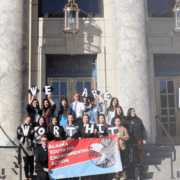
This past fall, 12 young Alaskans gathered in Anchorage for AYEA’s annual Youth Organizer Summit to imagine a better future together. Youth Organizers chose and began to plan their statewide project to protect & increase Alaskans’ access to local food through action & education. Throughout the pandemic and as climate change impacts worsen, the challenges surrounding food access and Alaska’s supply chain have become increasingly evident and extreme, showing that food security and access are significant issues across the state. AYEA Youth Organizers hope to make a difference for their local communities and Alaska through their ongoing project. They have big plans this next year. They will build out local AYEA chapters and raise awareness around the issue of food insecurity and access by bringing attention to food costs and access in rural Alaska. Collectively they will uplift the stories of those most impacted, learn and teach about traditional foods and subsistence practices, provide hunter training, and build greenhouses and community gardens. They will continue their advocacy throughout the year, culminating in Juneau during our annual Civics & Conservation Summit.
As our ocean rise, our climate becomes more extreme, and our food systems destabilize, leaders continue to invest in false solutions. It’s time leaders prioritize youth. It’s time they hear the facts and face the truth.
Alaska Youth for Environmental Action will be helping young people make their voices heard in Juneau at the 2023 AYEA Civics & Conservation Summit. The Civics & Conservation Summit is a unique opportunity for Alaskan teens to travel to Juneau, learn more about the AK State Legislature, connect to their representatives, and impact the passage of bills. The summit breaks down barriers between delegates and the Alaska State Legislature. By focusing on specific bills within the current Alaska State Legislative session, delegates will gain communication, advocacy, and civic participation skills. The summit culminates with constituent meetings between delegates and their legislators – when they can advocate for the bills and topics they care about!
Alaska’s young people are smart, creative, and passionate. With the tools, network, and support they deserve, young people can leverage their power and influence positive change for their communities. Any Alaskan teen 13-18 can apply to attend the summit themselves, and adults are encouraged to nominate delegates.
The new year is a time to be hopeful, and there’s good reason to be. At The Alaska Center, we work with inspiring, brilliant young Alaskans working tirelessly towards healthier, happier communities. It’s hard not to be hopeful. Help us kick off AYEA’s 25th year to a great start, and know that you are an integral part of the fight for a better tomorrow. Join us this year in making a new resolution: to support Alaska’s youth in becoming our next generation of community leaders and changemakers. 

P.S. Make good on your promise by nominating a young person today as a delegate to the 2023 Civics & Conservation Summit, March 17-21 in Juneau.
Nominate a teen by Jan 7th, apply to be a delegate by Jan 15th, or learn more at ayea.org or by emailing [email protected].
The Alaska Center

\n\n[/cs_content_seo][cs_element_gap _id=”5″ ][cs_element_button _id=”6″ ][cs_content_seo]More Hot Takes In A Cold Place\n\n[/cs_content_seo][/cs_element_layout_column][/cs_element_layout_row][/cs_element_section][/cs_content]
https://akcenter.org/wp-content/uploads/2023/01/Hot-Takes-Banner-8.png 400 1200 Megan Kelley https://akcenter.org/wp-content/uploads/2025/02/the-alaska-center-with-tag.svg Megan Kelley2023-01-06 18:42:142023-01-06 18:42:14A New Year In Youth Engagement

Climate Progress Ahead

December 9, 2022/in Blog, Clean Energy, Climate, Legislative Session

There is a thread in these facts. Joe Biden is arguably the most aggressive president on climate we have had, and this administration has shepherded through Congress the most significant investment in clean energy our country has ever seen. A national party has a majority in the U.S. Senate and will hopefully treat climate change as the dire threat it is. Alaska just elected the first Indigenous Alaskan woman to Congress who knows first-hand the impacts of climate change on northern lands, waters, and communities. The Governor, no great champion of Salmon or Democracy, has put forward bold renewable energy policies in the past and is compelled to diversify energy sources by a looming Southcentral natural gas shortage bearing down.

Similarly, major electric utilities are awakening to the fact that they must quickly diversify. The State Senate has organized a moderate bi-partisan majority with the goal of driving down energy costs as a key pillar of the coalition. While the State House has yet to organize, it will be hard for any majority to oppose further clean energy investment and legislation if it helps drive down costs for Alaskans. If we mind the connections, progress seems inevitable – but that is never the case. Progress will take a lot of work, a lot of voices, and a little time.
The Alaska Center understands that there are enormous resources now available to states, local governments, and utilities from the Inflation Reduction Act and that the political stars are fairly aligned. For our climate-oriented legislative priorities we will be working to pass a suite of state legislation that will move the needle on climate impacts. Our top priority is a bill that authorizes and provides clear guidelines for community solar projects. We will also be working with a coalition of organizations to pass legislation that sets a renewable portfolio standard for railbelt electric utilities, creates a clean energy investment bank, and extends the Renewable Energy Fund to facilitate utility-scale renewable energy projects.

All Alaskans should have access to the cost reductions and pollution reductions available to those with the financial means to take advantage of residential solar. Alongside individual and large-scale solar, Community Solar is a way for everyone to benefit from solar energy, even if they cannot afford or install a solar PV system. An array is built, and residents, from homeowners to business owners to organizations, can invest in the array. The production of that array will be reflected in our energy bills. This array can be managed by a utility or a community for off-grid regions and villages. Electric utilities like Chugach and Homer Electric Association have come close to adopting versions of community solar programs. We believe that providing a clear statutory framework for utilities and the Regulatory Commission of Alaska to follow will provide for community solar arrays in underserved communities.

Electric utilities in Alaska have been told by the sole provider of natural gas in Southcentral Alaska that long-term natural gas contracts will end after 2024. This injects instability into future budget forecasting for utilities, and monopolistic control of the gas supply generally guarantees utility customers will pay increased premiums for the cost of power from natural gas. A renewable portfolio standard bill must be re-introduced to push our utilities toward the inevitable and the cost-effective: more renewable energy, lots more, and fast. When Congress passed the Inflation Reduction Act this year, they authorized a provision that non-profit rural electric cooperatives across the nation have sought for years – direct payment equivalent to the federal tax credit that for-profit utilities and Independent Power Producers claim. This means that our utilities have significant federal backing for numerous shovel-ready renewable projects, which also deeply undercuts the utility manager’s argument that individual utilities cannot afford a massive transition to renewables and battery storage. As envisioned by the Governor last session, a renewable portfolio standard would have utilities reach 80% renewable generation by 2040. We will be working to see this framework pass the legislature.

Our other policy goals align with and will help our state achieve the 80% goal. Reauthorization of the Renewable Energy Fund (REF)-due to sunset this year, will maintain an essential space for new utility-scale renewable projects to be vetted and funded. Funding for the REF has lately been derived from the earnings of the Power Cost Equalization endowment. When the state was flush with oil money, the REF was capitalized by appropriations from the general fund. We must maintain a way to provide direct grants for large-scale renewable projects as we simultaneously mandate that utilities incorporate more renewable energy.

Alaska needs a clean energy investment organization to help coax the private lending industry into making low-interest loans for large-scale energy efficiency projects, clean transportation, and clean energy programs. The Inflation Reduction Act authorized the Greenhouse Gas Reduction Fund (GGRF), a $27 billion clean energy deployment bank housed at the Environmental Protection Agency. The GGRF is the largest single pot of funding enacted in the IRA. It gave EPA broad discretion to invest in clean energy technologies through Green Banks (entities that leverage public funding to attract private financing and advance green energy or energy efficiency projects). We will be working this session to ensure a state office is established to take advantage of federal GGRF funds, a significant portion of which is designated for investment in underserved communities.

The Biden climate investment, favorable political conditions in Alaska, decreasing natural gas supply and price certainty, and the upcoming legislative session are primed for clean energy progress.

2023 can be the year for clean energy progress in our state if we keep pushing our leadership to enact policy that works with and for all Alaskans.

To the future!

https://akcenter.org/wp-content/uploads/2022/12/Hot-Takes-Banner-6.png 400 1200 Megan Kelley https://akcenter.org/wp-content/uploads/2025/02/the-alaska-center-with-tag.svg Megan Kelley2022-12-09 21:02:132025-01-06 05:27:59Climate Progress Ahead

The Dust Settles and the Future Takes (a bit of) Shape

December 2, 2022/in Blog, Clean Energy, Democracy

[cs_content][cs_element_section _id=”1″ ][cs_element_layout_row _id=”2″ ][cs_element_layout_column _id=”3″ ][cs_element_text _id=”4″ ][cs_content_seo]After the fanfare of the general election fades away and the nail-biter races are called, the action moves to the task of legislative organization – who will be in charge of what, who will wield the levers of power, and who will not. This can take no time or a very, very long time, depending on the ideological schisms of those elected.
The State Senate has rapidly coalesced around a 17-member bipartisan majority. Likely this formation was in the works after the August primary numbers came in, given the patchy trend (but trend indeed) of voters electing the more moderate candidate. This organization has many strong champions of education at the helm, and recent statements indicate that the coalition’s focus will be to protect education, grow the economy and address high energy costs in Alaska. At this point, we are prepared for a pretty low-key fireworks show in the Senate compared to the last four years. We anticipate the Senate will be a strong barrier against Governor Dunleavy’s more damaging budget proposals.
The fact that the Governor previously proposed a Renewable Portfolio Standard and a Green Bank for clean energy investments last session, the fact that long-term natural gas supply contracts in SouthCentral Alaska are ending in 2024, the fact that the floodgates are open on federal clean energy infrastructure program money, and the fact that the state Senate is clearly indicating it wants to work on energy costs – are good facts for our legislative priorities at The Alaska Center.
Our priority goals to help Alaskans lower energy costs and to address climate change are as follows: 

Pass a Renewable Portfolio Standard that will allow Alaska Railbelt utilities customers to purchase energy from 80% renewable sources by 2040.
Pass Community Solar legislation that will allow more Alaskans to benefit from renewable energy.
Extend the Renewable Energy Fund. 

Stay tuned for more on these and other clean energy priorities in our next blog!
Whether the State House will rally around similar general goals (education, economy, energy) as the Senate is now an open question. The House is in a more protracted organizing process and will not know until after December 21 if one member is eligible to take his seat until the courts determine if he is in violation of the Alaska Constitution’s Disloyalty Clause. However the House organizes, the numbers trend toward moderation with 6 Independents, 13 Democrats, and 21 Republicans. We hope for a continued Bipartisan Coalition in the House that will work towards a more thriving, just, and sustainable future.
If the Governor is moderated by the Senate bipartisan coalition, the House Republicans will be moderated by the Governor’s goals – that is our prediction anyway. It bodes well for meat and potato issues like driving down energy costs for Alaskans through increases in clean energy, and we can work with that.
Talk to you soon,
The Alaska Center\n\n[/cs_content_seo][cs_element_gap _id=”5″ ][cs_element_button _id=”6″ ][cs_content_seo]More Hot Takes In A Cold Place\n\n[/cs_content_seo][/cs_element_layout_column][/cs_element_layout_row][/cs_element_section][/cs_content]

https://akcenter.org/wp-content/uploads/2022/12/Hot-Takes-Banner-4.png 400 1200 Megan Kelley https://akcenter.org/wp-content/uploads/2025/02/the-alaska-center-with-tag.svg Megan Kelley2022-12-02 21:28:442022-12-02 21:28:44The Dust Settles and the Future Takes (a bit of) Shape

Bringing Community Solar To Alaska

November 11, 2022/in Blog, Clean Energy, Climate, Legislative Session

[cs_content][cs_element_section _id=”1″ ][cs_element_layout_row _id=”2″ ][cs_element_layout_column _id=”3″ ][cs_element_text _id=”4″ ][cs_content_seo]Renewable energy has become quite the buzz phrase in our world these days. Sometimes it takes other forms; clean energy, green energy, sustainable energy, but it is scattered through ads on radio stations, tv commercials, and even announced over the loudspeakers at airports. Sometimes through all this noise, it is hard to understand what renewable energy means to the average person. 
The Inflation Reduction Act passed this summer included groundbreaking funding for renewable energy projects, as did the Bipartisan Infrastructure Package that passed in the months before. With this new funding, utility cooperatives across the state are (or at least should be) looking for new renewable energy projects to bring onto the grid, which will benefit all Alaskans. 
Transitioning our state away from fossil fuels and into cleaner energy sources creates better air quality, and less pollution to our water sources and wildlife habitat. It will ultimately give us cheaper and more sustainable energy. However, right now in Alaska, affordable renewable energy is more accessible for folks with resources to invest in their small-scale solar or wind projects. It is time for that to change. 
Community solar is a system where individuals can invest in and share the benefits of a solar array not located on their property. Each person who holds a share of the community solar array will see their portion of clean, sustainable energy on their utility bill each month. You can start to reap the benefits of having a solar setup without the upfront cost that so many of us can’t afford. This also opens up solar energy to people who have yet to participate: renters, condo owners, and anyone who doesn’t have space in their backyard or roof for a solar system can join the solar movement. It democratizes the energy transition and allows more Alaskans to contribute to and earn returns from renewable energy. 
While 41 states already have community solar arrays, the great state of Alaska is one of the few without one installation. Many people may not think of solar when they think of Alaska, yet they should. Our winters may be long and dark, but the sunlight hours we have access to in the summer make up for the winter and then some. In fact, for seven months out of the year, Anchorage gets more hours of daily sunlight than anywhere in the contiguous US! 
Community solar is a step forward for our state that can be unlocked with policy change. Our leaders in Juneau can make community solar available to all Alaskans with some simple regulatory changes. Community solar is just one of many great opportunities for Alaska; we have immense renewable energy potential that our elected leaders can and should tap into. This coming legislative session, we can push them to do it. We will keep you updated as the legislative session unfolds on how you can take action to make Community Solar a reality in Alaska.

\n\n[/cs_content_seo][cs_element_gap _id=”5″ ][cs_element_button _id=”6″ ][cs_content_seo]More Hot Takes In A Cold Place\n\n[/cs_content_seo][/cs_element_layout_column][/cs_element_layout_row][/cs_element_section][/cs_content]

https://akcenter.org/wp-content/uploads/2022/11/Hot-Takes-Banner-5.png 400 1200 Megan Kelley https://akcenter.org/wp-content/uploads/2025/02/the-alaska-center-with-tag.svg Megan Kelley2022-11-11 18:46:512022-11-11 18:46:51Bringing Community Solar To Alaska

A Just Transition to an Indigenized Future

November 4, 2022/in Blog, Clean Energy, Climate, Democracy, Salmon

[cs_content][cs_element_section _id=”1″ ][cs_element_layout_row _id=”2″ ][cs_element_layout_column _id=”3″ ][cs_element_text _id=”4″ ][cs_content_seo]November is Native American Heritage Month. Here in Alaska, this means centering the people who have shaped this land since time immemorial. Around 20% of Alaska’s population is Indigenous, but Native culture plays a much more significant role in our history and in our future. Alaska Natives have stewarded these lands successfully for 10,000 years – we live every day on Native Land. Native American Heritage Month is a time to reflect on this legacy of stewardship and look forward.
To heal from past crimes and solve our most dire social and political problems, we must work to Decolonize and Indigenize our ways of life. As a conservation organization, this means owning our place in colonizing history. It also means looking at new ways to understand and build a future together. It means learning from elders and revitalizing Native languages; upholding self-determination for tribes and shifting funding to Native tribes, villages, and organizations; living within the limits of the land and eating local foods, and deep listening. Everyone who lives in Alaska – Native or not – can do these things.
This reframing, collective healing, and visioning are what a Just Transition aims to do. “Just Transition” refers to a transition away from extractive industries and practices like oil and gas and historically colonial ideas of community and economy. A Just Transition moves us towards practices informed by Indigenous knowledge. A Just Transition doesn’t aim to return us to the world as it was before settlers set foot in Alaska; a Just Transition seeks to choose policies that will be best for all Alaskans.
We already see examples of Just Transition principles at work. We see it in the recent election of Mary Peltola, the first Alaska Native woman in Congress. We see it in the failure of ANWR lease sales and the emergence of small-scale solar projects in rural Alaska. We see Just Transition embodied in Native leadership at all levels of government, including in the co-management of Alaskan lands and waters. And we see it in the reemergence of Native languages in our schools and towns. These accomplishments, and many more, are thanks to the hard work and vision of Indigenous leaders across the state.
But we have so much work left to do.
Next week, our state and country will head to the polls. These are the lands of the Dena’ina, Tlingit, Haida, Ahtna, Sugpiak, Tanana Dene, Yup’ik, Inupiat, and so many more, and our politics must reflect this. We must ensure that Native communities have full and unrestricted access to voting by translating ballots and information into Native languages, providing voting assistance for elders, and streamlining voter registration and voting by mail. We must elect leaders who will represent all Alaskans. We need Native leadership and leadership that listens to Native communities. The table needs to expand. A transition is inevitable; justice is not. However, those sitting at our decision-making tables can ensure that the transition is a just one and no Alaskans are left behind.
Voting is a vision for the future. Our choices at the polls must reflect our understanding and history with these lands, but they also must shine a light toward a thriving future for All Alaskans.
Happy Native American Heritage Month, and happy voting.
Don’t forget to have your absentee ballot postmarked or go vote in-person by November 8. This is a huge election and our values are on the line.
The Alaska Center

\n\n[/cs_content_seo][cs_element_gap _id=”5″ ][cs_element_button _id=”6″ ][cs_content_seo]More Hot Takes In A Cold Place\n\n[/cs_content_seo][/cs_element_layout_column][/cs_element_layout_row][/cs_element_section][/cs_content]

https://akcenter.org/wp-content/uploads/2022/11/Hot-Takes-Banner-4.png 400 1200 Megan Kelley https://akcenter.org/wp-content/uploads/2025/02/the-alaska-center-with-tag.svg Megan Kelley2022-11-04 18:01:102022-11-04 18:01:10A Just Transition to an Indigenized Future

Big Energy for Clean Energy

September 29, 2022/in Blog, Clean Energy, Climate

October is “National Energy Awareness Month,” designated by a decree from the late president George Herbert Walker Bush in 1991. We at The Alaska Center believe that every month gives us reason to promote energy efficiency and renewable energy production, considering what is at stake without a rapid global transition to low-carbon energy sources. The recent storms that battered the Bering Sea and Norton Sound region point to the urgency. Energy awareness also saves homes and businesses money and creates local jobs.

Collective work to create a more energy-aware state includes new additions to our Solarize programs, celebrating the first deal under Anchorage’s Commercial Property Assessed Clean Energy program and CPACE’s expansion to the Mat-Su Borough, helping steward public involvement in the Fairbanks Climate Action and Adaptation Plan.

Solarize Fairbanks facilitated two communities this season, University Heights and Denali, with 94kW purchased and over 16 homes and businesses solarized. That brings the initiative to just under a megawatt, rising at 893.35kW purchased and installed across the Interior. The team hosted community listening sessions during September to gain valuable feedback on evolving the Solarize model for 2023.
Solarize Mat Su held its first campaign this year! We facilitated programs in the Palmer and Sutton/Chickaloon communities. Installations are still underway, but at least 35 homes have Solarized. We will have an end-of-year celebration for those communities participating when installation season is over, expected in late October to early November.

Solarize Anchorage and Solarize Mat Su will start the 2023 season on October 6th with a kickoff webinar>>

Rachel Christensen and Chris Pike with The Alaska Center for Energy and Power will walk you through how your community can Solarize. Solarize Mat-Su will also be hosting an informational session in Talkeetna at the Denali Education Center on October 13th at 6:00 pm. We are currently planning many community events throughout October and November, so if you are interested in attending one, please head to our Facebook page to stay up to date!

The first Commercial Property Assessed Clean Energy loan closed in Anchorage this fall. This program, adopted by municipal ordinance and authorized by state law, attaches an energy efficiency or renewable energy project loan to a property instead of an individual and allows the owner to pay the loan back as a line on their property tax bill. The project’s energy savings are often equal to or greater than the annual loan repayment charge, making the program cash neutral. The Mat-Su Borough Assembly is currently considering adopting CPACE. Our work hosting the Alaska Municipal Climate Network has helped local government leaders connect on policies, including CPACE, which we hope to see expand to local governments statewide.

Climate Action starts at home, the individual business, and the local government level. We are pleased to support the creation of a Climate Action and Adaptation Plan (CAAP) within the Fairbanks North Star Borough. Throughout this fall, our Interior Community Organizing Manager, Alyssa Quintyne, along with other The Alaska Center staff, will be working with Fairbanks Climate Action Coalition and other community leaders to ensure that the public has all of the tools they need to support the creation of a CAAP to guide energy decisions at the borough. Find more information, meeting dates, and links to the draft CAAP visioning document here>>

Throughout October and the rest of 2022, The Alaska Center will be focused on moving the ball forward on energy, with energy.
Thank you. Have a restorative energy weekend.
-The Alaska Center Team

https://akcenter.org/wp-content/uploads/2022/09/bigenergybanner.png 400 1200 Megan Kelley https://akcenter.org/wp-content/uploads/2025/02/the-alaska-center-with-tag.svg Megan Kelley2022-09-29 19:58:072025-01-06 05:28:42Big Energy for Clean Energy
Page 5 of 6«‹3456›

Categories

  • Accountability (23)
  • AYEA (3)
  • Blog (130)
  • Clean Energy (59)
  • Climate (60)
  • Democracy (62)
  • Leg with Louie (27)
  • Legislative Session (47)
  • News (36)
  • OpEd (3)
  • Press Releases (5)
  • Salmon (15)
  • Uncategorized (9)
  • Volunteer (8)

Archives

3350 Commercial Dr, Ste 101
Anchorage, AK 99501

(907) 274-3621

  • Link to Facebook
  • Link to X
  • Link to Instagram
  • Who We Are
    • Mission
    • Staff
    • Board
    • Careers
  • Our Programs
    • Electing Leaders
    • Climate & Clean Energy
    • Salmon & Clean Water
  • Take Action
    • Donate
    • Volunteer
  • Learn More
    • Hot Takes in a Cold Place
    • Events
  • Our Organizations
    • The Alaska Center Education Fund
    • Trailside Discovery Camp
    • Alaska Youth for Environmental Action
Scroll to top Scroll to top Scroll to top

Support The Alaska Center

Donate Now

$20
$35
$50
$100
$500
$2500