• Who We Are
    • Our Mission
    • Meet Our Staff
    • Meet Our Board
    • The Alaska Center Education Fund
  • Our Programs
    • Electing Leaders
      • Endorsements
    • Climate & Clean Energy
      • Clean Energy Stories
    • Salmon & Clean Water
  • Stay Connected
    • Hot Takes in a Cold Place
    • Become a Volunteer
    • Email Sign Up
    • Events
    • Careers
    • Ways to Give
    • Contact Us
  • Donate
  • Menu Menu

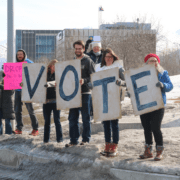
Climate activists hold rally near the Capitol

February 6, 2023/in News

[cs_content][cs_element_section _id=”1″ ][cs_element_layout_row _id=”2″ ][cs_element_layout_column _id=”3″ ][cs_element_text _id=”4″ ][cs_content_seo]Climate activists from around Alaska held a rally near the Alaska State Capitol Friday afternoon in support of legislative action to improve Alaska’s renewable energy development and future sustainability.
“What we do today right here, how our voices rise up from Áak’w Kwáan land all the way up through this building will only affect us, it will affect all our generations,” said Paulette Moreno, Tlingit climate activist and member of the Indigenous Navigation Council. “It is important that our voice be heard.”
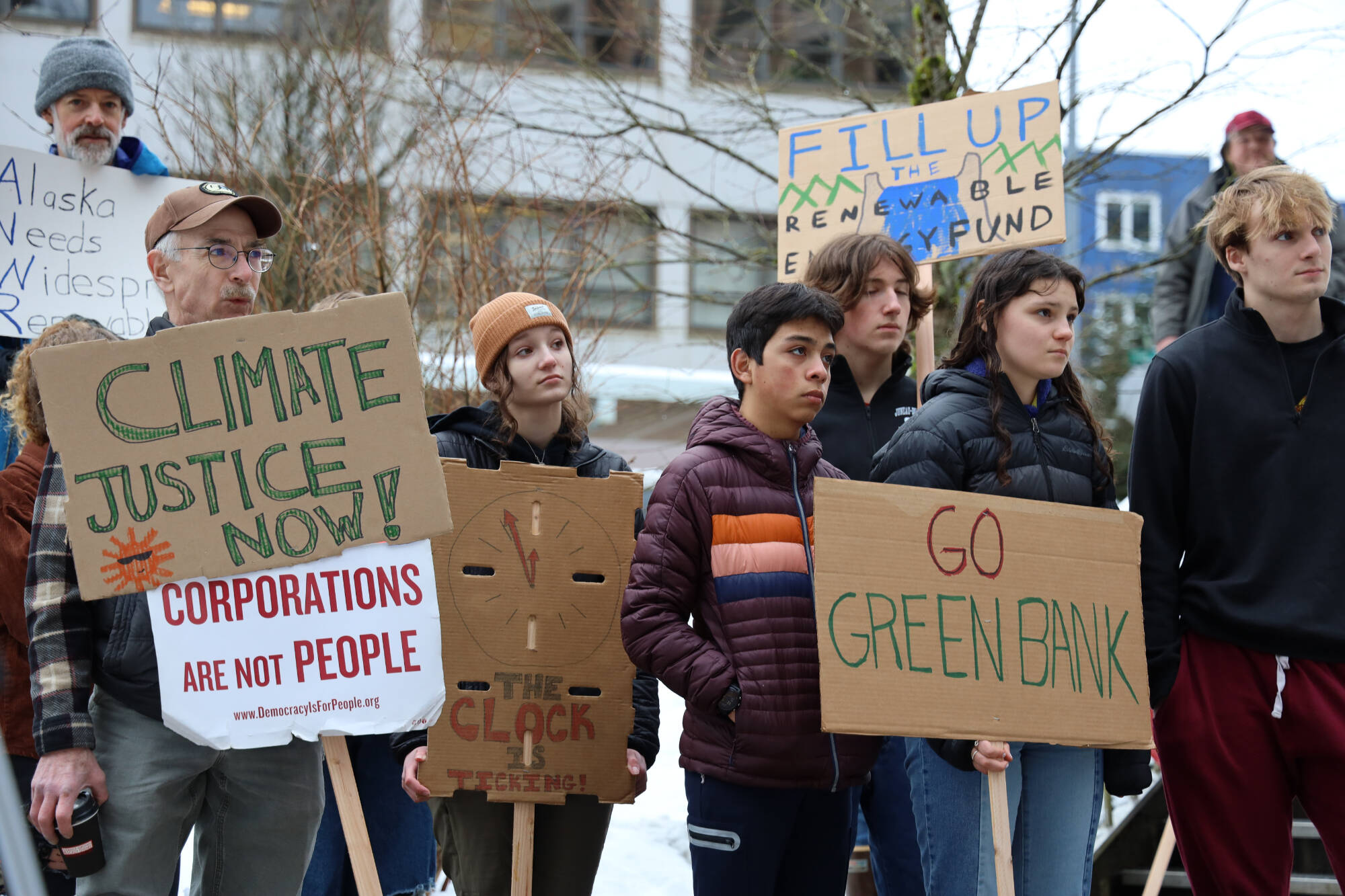
Around 30 people attended the snowy rally at the Dimond Courthouse Plaza holding signs and planting them in a pile of snow that gathered around the William Henry Seward statue.

Clarise Larson / Juneau Empire Climate activists hold a rally outside the Alaska State Capitol Friday afternoon in advocacy for legislative action to improve Alaska’s renewable energy development and future sustainability.

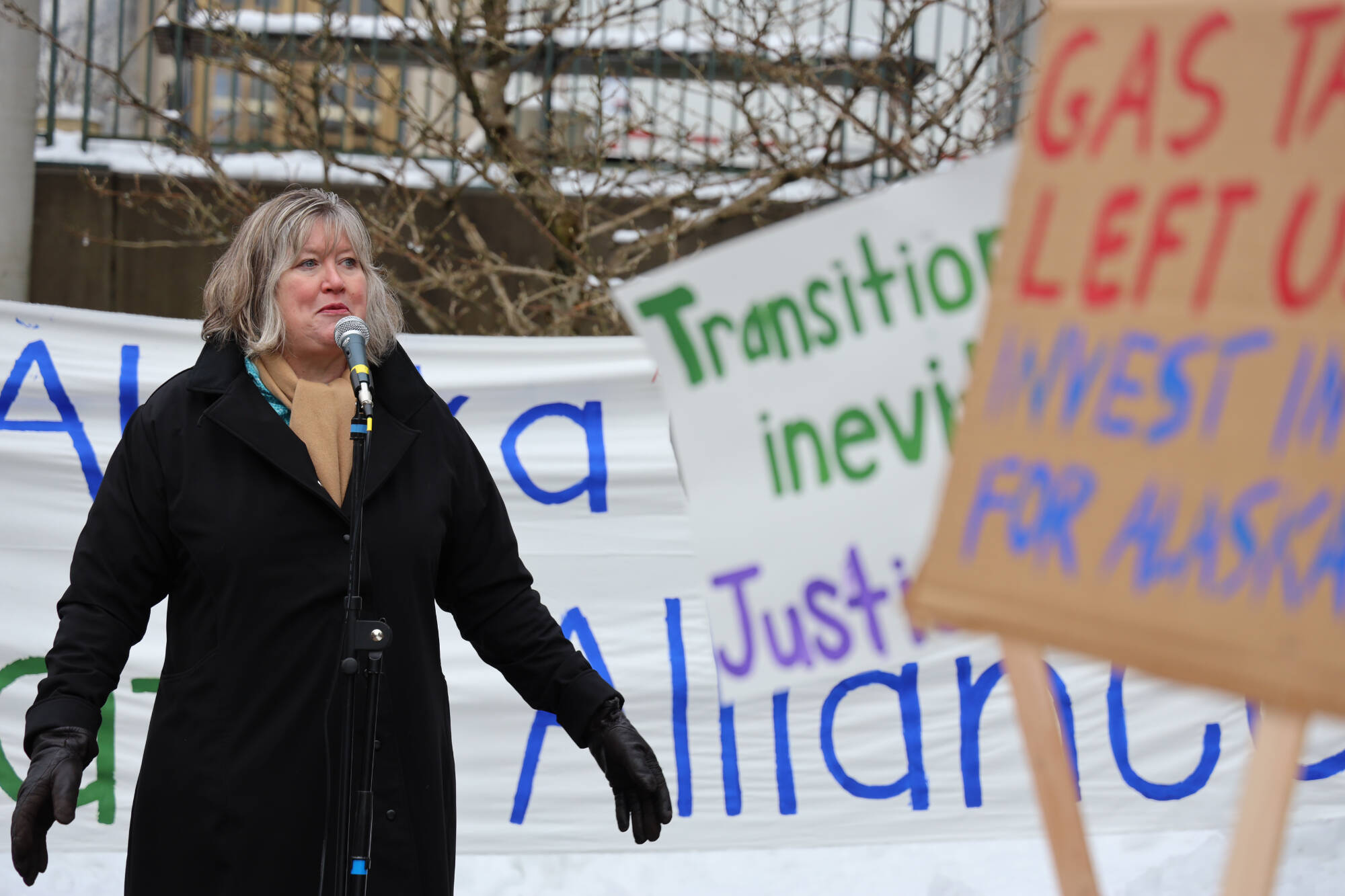
The group included multiple leaders of climate activist organizations from across the state and legislators including Democrats Rep. Sara Hannan of Juneau, Rep. CJ McCormick of Bethel, and Rep. Donna Mears of Anchorage and independent Rep. Alyse Galvin of Anchorage.

Clarise Larson / Juneau Empire Independent Rep. Alyse Galvin of Anchorage speaks to a crowd of climate activists who held a rally outside the Alaska State Capitol Friday afternoon in advocacy for legislative action to improve Alaska’s renewable energy development and future sustainability.

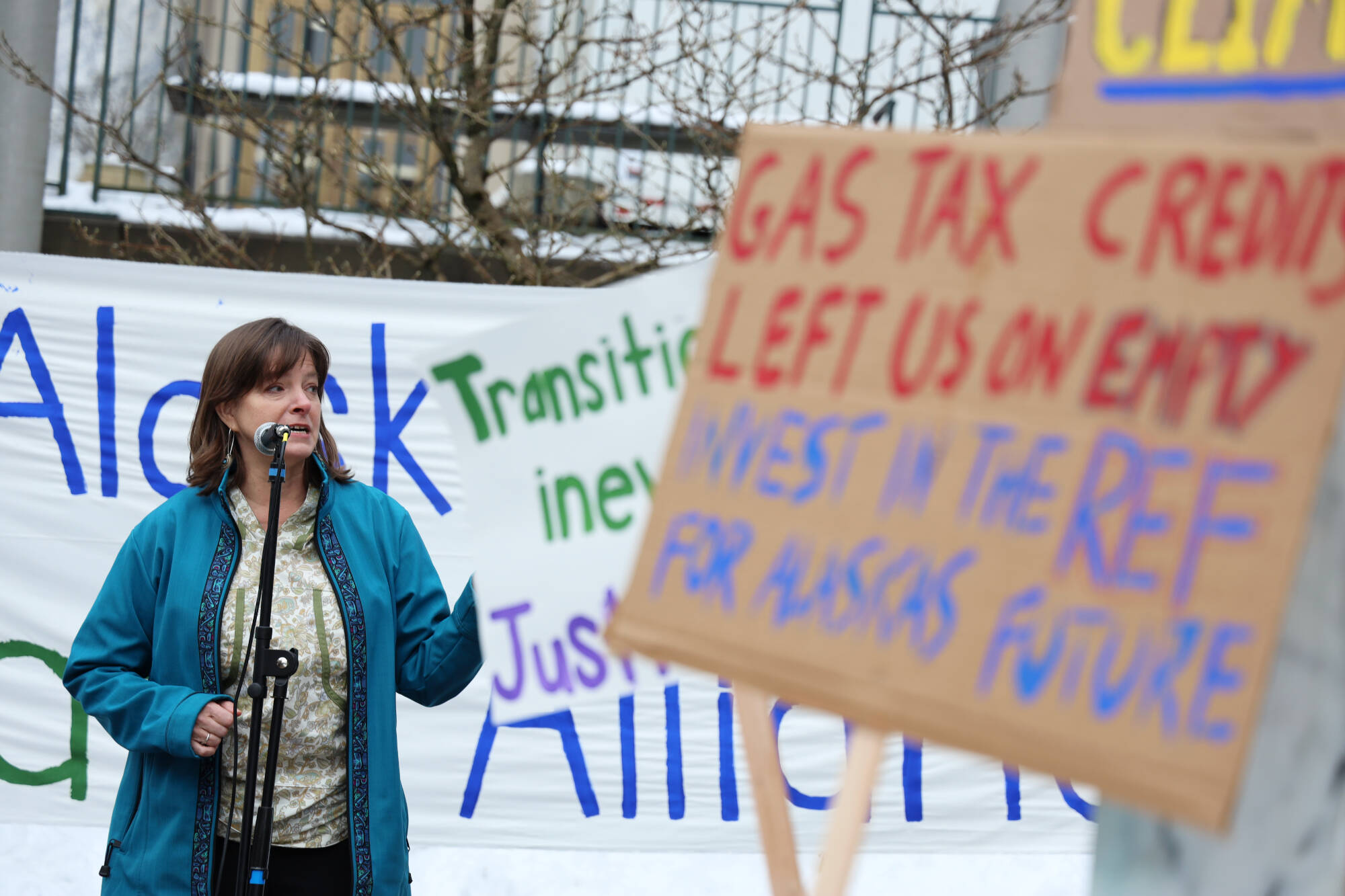
The handful of speakers from groups a part of Alaska Climate Alliance including the Southeast Alaska Conservation Council, 350Juneau, Fairbanks Climate Action Coalition and the Alaska Center advocated for action on four legislative priorities which included establishing a Green Bank within the Alaska Housing Finance Corporation, enacting a Renewable Portfolio Standard, passing Community Solar legislation and renewing and strengthening the Renewable Energy Fund.
“We need our senators and representatives to wake up to the enormity of the climate crisis,” said Elaine Shroeder, co-chair of 350Juneau, in an interview with the Empire.
Hannan, Mears and Galvin each gave a short speech to the crowd and said it can be hard to change certain legislators’ minds when it comes to the need for climate action, and said changes come at the ballot box.

Clarise Larson / Juneau Empire Rep. Sara Hannan of Juneau speaks to a crowd of climate activists who held a rally outside the Alaska State Capitol Friday afternoon in advocacy for legislative action to improve Alaska’s renewable energy development and future sustainability.

“With 17 new members in the House, our age going down, we were very successful in replacing some old staunchly oil advocates with some young renewable advocates and in two years we have the opportunity to change more seats and we have to continue to do it,” Hannan said.
Hannan said she wanted to see other Alaska communities — large and small — find similar success in renewable energy as Juneau has been able to. She also pointed to heat pumps as an energy efficient alternative to furnaces that has been largely adopted in Juneau and said she wants to see more communities in Alaska transition to the alternative heating mode.
In an interview with the Empire after the event, Hannan said she is supportive of renewing the Renewable Energy Fund but said it was too early in the budgeting process to say how much more she’d like to see be included with the renewal.
“If we don’t extend it, it evaporates,” she said.
In response to a rally participant suggesting adding $100 million, Hannan noted to the Empire that the state’s budget for the fiscal year 2024 is expected to spend at a deficit. Gov. Mike Dunleavy’s proposed budget for Fiscal Year 2024 includes a projected $250 million deficit that will need to be covered with the state’s roughly $2 billion in reserve funds, but legislative finance leaders say the actual deficit is may be $400 million to $500 million.
Hannan said she thinks a key solution to increasing renewable energy across Alaska is the use of run-of-river hydroelectricity, systems that use natural water flow to generate electricity, which is an energy system Juneau has been benefiting from and pioneered since early hydropower development. Hannan said she is interested in projects bringing opportunities to expand run-of-river hydroelectricity into small and rural communities in Alaska.

Originally published on February 3, 2023 by the Juneau Empire.\n\nClarise Larson / Juneau Empire Climate activists hold a rally outside the Alaska State Capitol Friday afternoon in advocacy for legislative action to improve Alaska’s renewable energy development and future sustainability.Clarise Larson / Juneau Empire Independent Rep. Alyse Galvin of Anchorage speaks to a crowd of climate activists who held a rally outside the Alaska State Capitol Friday afternoon in advocacy for legislative action to improve Alaska’s renewable energy development and future sustainability.Clarise Larson / Juneau Empire Rep. Sara Hannan of Juneau speaks to a crowd of climate activists who held a rally outside the Alaska State Capitol Friday afternoon in advocacy for legislative action to improve Alaska’s renewable energy development and future sustainability.[/cs_content_seo][/cs_element_layout_column][/cs_element_layout_row][/cs_element_section][/cs_content]
https://akcenter.org/wp-content/uploads/2023/02/AKClimateAllianceRally_JNU2023.png 630 1200 Megan Kelley https://akcenter.org/wp-content/uploads/2025/02/the-alaska-center-with-tag.svg Megan Kelley2023-02-06 18:26:162023-02-06 18:26:16Climate activists hold rally near the Capitol

OPINION: Time to prep your solar garden

January 30, 2023/in News

Alaskans understand working together to help each other thrive. We have community hunts, mutual aid networks and community gardens all across the state. We come together to use a common plot of land to increase the harvest for all, but we can garden more than food: We can garden electricity!

Gardening is a great way to boost your mood, spend some time outside and save a bit of money on food. We could all use the extra sunshine and a few dollars saved on groceries, but how do you garden if you live in an apartment? What if your yard just doesn’t get the sun you need, or you’re not quite sure how to make those nice raised garden beds? Join a community garden! You can build community, share space with your neighbors, and get all the benefits of a garden in your backyard without needing a backyard. Solar gardens can solve the same problems for people looking to invest in renewable energy.

Solar energy has been gaining a lot of popularity in Alaska over the last few years. The same summer sun that grows us record-breaking veggies also produces power that helps Alaskans all across the state save money on their energy bills and reduce their dependence on fossil fuels. I help facilitate Solarize programs in Mat-Su and Anchorage communities whose goal is to help people get solar on their homes, but as the renter of a log cabin hidden in the woods, I can’t put solar on my roof. It wouldn’t get enough sunlight, and I would have to pay for structural remodels of a house I don’t own. A solar garden would let me, and others like me, invest in a solar setup located in a clear sunny patch and save money on my electric bill without the cost of a remodel.

Solar gardens are made possible by community solar programs. Community solar is a system where individuals can invest in and share the benefits of a solar array not located on their property. Each person who holds a share of the community solar array will see their portion of clean, sustainable energy on their utility bill each month. Programs like these significantly reduce solar costs, helping make solar more accessible to folks who don’t have a roof to put their solar on and who can’t afford to put solar on their roof.

While Alaska does have the second-highest energy prices in the U.S., we do not have legislation permitting community solar. Forty-one other states already have community solar projects up and running, and we can join them if our legislators pass a bill allowing us access to solar gardens. For many of us, access to energy is just as important as access to food, and both commodities’ prices are increasingly challenging to afford. If you want to grow some electricity in a solar garden near you like I do, then we will need our leaders to make policy decisions to ensure community solar is possible here. It’s time to plant those seeds for community solar this legislative session.
Rachel Christensen is a community organizer for The Alaska Center who loves clean energy, dog walks and new crafts.

Originally published on January 27, 2023 by the Anchorage Daily News.

https://akcenter.org/wp-content/uploads/2023/01/Hot-Takes-in-a-Cold-Place-3.png 630 1200 Megan Kelley https://akcenter.org/wp-content/uploads/2025/02/the-alaska-center-with-tag.svg Megan Kelley2023-01-30 19:58:402025-01-06 05:23:31OPINION: Time to prep your solar garden

Defending Democracy In 2023

January 25, 2023/in News

[cs_content][cs_element_section _id=”1″ ][cs_element_layout_row _id=”2″ ][cs_element_layout_column _id=”3″ ][cs_element_text _id=”4″ ][cs_content_seo]2022 was a record-breaking year at Alaska polls for more reasons than one. Voters went to the polls for no less than four statewide elections, with a special primary and a special general election to fill the late Don Young’s seat, followed by a regular primary and regular general election. It was also our first year using ranked-choice voting (RCV) and open primaries, which Alaskans voted to implement by ballot measure in 2020.
The results of these changes were also monumental. Alaskans elected Mary Peltola as U.S. Representative not once but twice, and she is now our first-ever Alaska Native woman elected to Congress. Another success came from the formation of the Senate Bipartisan Majority in the Alaska Legislature, which is composed of Senators from both political parties who are willing to work together in the greater interests of the state.
Despite the successes of the most recent election, we still have a long way to go toward ensuring every Alaskan has access to voting. In both the August and November elections, ballots from several rural, mostly Native Alaskan villages were left uncounted due to mailing issues and polling places not opening. Additionally, following the June Special Primary, roughly 1 in 8 ballots were rejected in rural Alaska due to errors such as failing to include a witness signature. The failure to count thousands of Native votes in every statewide election this year follows a pattern of disenfranchisement of BIPOC voters in Alaska and around the country.
Looking forward to 2023, we must work hard to remedy these problems and maintain our gains. First, we must work to keep ranked-choice voting in place. RCV gives Alaskans more agency over their vote and encourages collaboration between candidates and politicians rather than division and antagonism. RCV is proven to be a simple system favored by most voters, and we must defend RCV against any attacks from extremist party interests.
We also hope to see measures for ballot-curing in Alaska. Ballot-curing allows voters to fix any issues with their ballot rather than simply rejecting spoiled ballots outright. This would ensure that trivial mistakes don’t prevent a vote from being counted. Additionally, we hope to see measures to decrease bureaucratic barriers to voting, such as eliminating the witness signature for mail-in ballots. By alerting voters of issues with their ballots – and removing as many areas for potential mistakes as possible – the Division of Elections can minimize the number of disenfranchised voters, particularly in underrepresented communities.
Many more voting reforms must be made to defend our democratic voting rights and stop voter suppression. We must increase poll worker training and wages to reflect the importance of the job and invest in face-to-face assistance at the polls. We must streamline absentee voting by including free postage in all mail-in ballots to remove all financial barriers to voting. We must give workers time off on election day so that no one has to choose between their job and voting. And we must allow for same-day registration on election day.
As we approach the beginning of the Legislative Session, we must demand that ranked-choice voting remains in place alongside changes to Alaska’s election system that will stop voter suppression and expand access to voting. Our senators and representatives are in Juneau because we, the voters, sent them there. It’s their job and ours to make sure every Alaskan has the freedom to vote.

Carly is the Voter Outreach and Engagement Fellow for the Alaska Center.
She is grateful to have been born and raised on Dena’ina lands.

Originally published on January 24, 2023 by Sol de Medianoche.

\n\n[/cs_content_seo][/cs_element_layout_column][/cs_element_layout_row][/cs_element_section][/cs_content]

https://akcenter.org/wp-content/uploads/2023/01/Voting_Banner.png 630 1200 Megan Kelley https://akcenter.org/wp-content/uploads/2025/02/the-alaska-center-with-tag.svg Megan Kelley2023-01-25 00:12:182023-01-25 00:12:18Defending Democracy In 2023

National climate draft document highlights dangers for Alaska

January 4, 2023/in News

The public comment period for an update on the National Climate Assessment closes Jan. 27 as the U.S. seeks to shore up efforts to address climate change.

The draft update, now the fifth, is considered “the preeminent source of climate information for the United States, used by hundreds of thousands of people across the country and around the world,” according to a news release from the White House Office of Science and Technology Policy.

The National Climate Assessment first published in 2000, with its last update released in two parts between 2017 and 2018.

The 1,695-page draft report evaluates everything from rising ocean levels and shifting weather patterns to economical and social impacts. The draft includes a 63-page chapter on Alaska’s role in climate change, including threats and reactions.

Citing a 2018 study, the draft states that Alaska is warming two to three times faster than the global average.

The draft report notes climate change presents some positive impacts for Alaska’s food security, including longer growing seasons.

Twenty-four people from federal, state, environmental, science and academic backgrounds contributed to the Alaska chapter.

Alyssa Quintyne, the Alaska Center’s Interior community manager, served as one of the Alaska chapter’s contributing writers.

“Alaskans are the best people to tell the story about climate crisis in Alaska,” Quintyne said, adding that public comments from Alaska residents are essential.

“We don’t want our chapter to go out without Alaskan eyes on it,” Quintyne said. “We want to engage with our fellow leaders and community members, and we want to make sure we got the story right.”

Noticeable impacts include thawing permafrost, shrinking sea ice levels and a sharp, noticeable drop in several fish and crab populations, which have led to several fisheries crashes over the last years.

Other elements highlighted in the draft report include prolonged summer wildfire seasons and the adverse health affects caused by the smoke, shifts in wildlife migration patterns.

Quintyne noted health impacts from wildfire smoke struck a personal note.

“A lot of my friends developed bronchospasms,” Quintyne said. Bronchospasms are cause by airway muscles tightening, which results in wheezing and coughing.

Quintyne noted some people had to receive breathing treatments as a result. Several things trigger it, including emphysema, chemical fumes and allergens — and wildfire smoke.

“To see healthy people that are normally out there running or exercising all of sudden developing these conditions hit me personally,” Quintyne said.

The report references some of the most recent severe weather events, including the harsh 2021-2022 winter season that hammered the Interior with freezing rain and snow.

The Alaska chapter also cites personal stories from residents, including Fairbanks resident and tax preparer Marjorie Casort’s testimony on the 2021-2022 snowpocalypse.

“In April we are still feeling the effects, with an inch of ice stubbornly clinging to roads,” Casort wrote. “Many of my elderly clients are housebound, unable to even cross the road to check their mailbox because of the dangerous ice conditions.”

The draft report is available online for review and comment at review.globalchange.gov. People wishing to comment will need to create an account to view, download or comment.

Quintyne encourages people to comment.

“We greatly appreciate having this chapter written and edited by Alaskans, so we appreciate any comment and we want to make sure we got the story right,” Quintyne said.

Originally published on January 4, 2023 by the Fairbanks Daily News-Miner.

https://akcenter.org/wp-content/uploads/2023/01/32682616471_252be0ec09_b.jpeg 573 1024 Megan Kelley https://akcenter.org/wp-content/uploads/2025/02/the-alaska-center-with-tag.svg Megan Kelley2023-01-04 23:58:182025-01-06 05:13:36National climate draft document highlights dangers for Alaska

Alaska power companies look at building community solar farms that households can invest in

November 28, 2022/in News

[cs_content][cs_element_section _id=”1″ ][cs_element_layout_row _id=”2″ ][cs_element_layout_column _id=”3″ ][cs_element_text _id=”4″ ][cs_content_seo]Two Alaska electric utilities are taking steps that could lead to the construction of the state’s first community solar farms, while a consumer interest group is drafting legislation that could support the efforts.
Advocates say the moves by the Anchorage and Fairbanks utilities could lead to projects that allow any household to invest in solar panels to reap their benefits, including low-income residents who can’t afford to install their own rooftop array like many Alaskans are doing.
Tom DeLong, board chair for the Golden Valley Electric Association in Fairbanks, said participants could invest in a share of a farm in potentially different ways, depending on how the utility might structure a plan. A ratepayer could make a one-time payment upfront, perhaps, or pay a tiny amount over time through a slightly higher electric bill. They could see lower electric bills in the years to come.
“It’s a hedge against rising rates,” DeLong said.
Chugach Electric Association, the largest utility in Alaska, is also beginning to take a new look at the idea of a community solar farm in Anchorage, after the Regulatory Commission of Alaska in 2019 rejected an earlier proposal from the utility, citing problems with details of the plan.
“Our members have expressed interest in community solar, so we are looking at the feasibility of another project,” said Julie Hasquet, a Chugach Electric spokeswoman.
Interest in the community farms, which have been implemented in many other states, comes as renewable use is growing in Alaska, and not just on rooftops. Private companies are undertaking ambitious efforts to build solar and wind farms, while utilities are also pursuing upgrades to the grid to support renewables. Driving factors include new federal tax incentives and uncertainty over future natural gas supply in Cook Inlet, the main source of electricity in Alaska.
[Construction of Alaska’s largest solar project gets underway in Houston]

‘Significant and vocal’ interest
Golden Valley Electric has directed its staff to study the idea of building a community solar array in Fairbanks, after a task force recommended that one be built on utility-owned land, DeLong said.
“We’re a cooperative, we’re owned by our members, and a significant and vocal group has expressed an interest in this,” DeLong said.
The task force recommended that residential ratepayers be allowed to buy a share of a panel to start with, and up to a full panel or more later, to facilitate broad participation in the project.
“We also recommend flexible eligibility that allows members to pre-purchase the panels in a six month or one year plan, in essence a Community Solar layaway plan,” the task force said in a report to the utility board. ”Smaller monthly payments will help accessibility by low to moderate income members in the community solar.”
The task force recommended the utility should quickly file a plan with the Regulatory Commission of Alaska.
The agency would approve how the payment is structured for participants, and would make sure a program does not discriminate against non-participants, DeLong said.

Chugach Electric will be informed by past effort
The Regulatory Commission in 2019 called Chugach Electric’s proposal for a community solar farm “confusing and undefined.” The agency raised concerns that all ratepayers would bear financial responsibility, not just the participants. But the regulators emphasized the state’s strong interest in renewable energy and said it did not want to discourage innovative programs.
That earlier proposal envisioned a solar farm built on utility-owned land in Anchorage, costing $2 million or less, with 2,000 panels. It could have generated about 15% of the power for about 500 participating households. Retail ratepayers could have made a prepaid investment or subscribed monthly, with the energy output of their share provided as a credit on monthly bills over the project’s 25-year life.
That earlier effort can inform this new proposal, Hasquet said. But Chugach Electric has no details proposed for this new round, Hasquet said.
“Understanding the concerns of the RCA with our previous project should help us craft a project that could get regulatory approval,” Hasquet said. “Many factors still need to be determined, including size, scope, and costs.”
[A small Fairbanks company wants to build Alaska’s biggest wind farms]
Chugach Electric recently sent a survey to “the more than 600 members who had shown interest in our 2017/2018 community solar project,” Hasquet said in an email. “We had a list of members who had asked to be kept informed of progress on a project. We believe that is a good place to start on determining the feasibility of a newly designed project.”

Groups working on draft legislation
The Alaska Public Interest Research Group is working with groups such as The Alaska Center to finalize draft legislation that could help enable the creation of the projects in Alaska, if it is approved by the Legislature, said Phil Wight, a policy analyst with the group.
The consumer interest group supports community solar farms because they’re another way to lower electric rates, he said. The Alaska Center also highlights climate benefits as another good outcome, as solar power replaces energy from fossil-fuel sources such as natural gas.
Legislation supporting community solar farms could create jobs, diversify the economy and help Alaska achieve its goal of 50% renewable energy by 2025, said Rachel Christensen, clean energy organizer with The Alaska Center.
[CIRI looks to triple power at Fire Island wind farm]
Wight said it’s a promising time for the projects in part because tax credits in the federal Inflation Reduction Act passed in August could cut project costs in half, or more.
“It’s really about bringing the lowest-cost energy to Alaskans,” he said.

Originally published on November 27, 2022 by the Anchorage Daily News.\n\n[/cs_content_seo][/cs_element_layout_column][/cs_element_layout_row][/cs_element_section][/cs_content]

https://akcenter.org/wp-content/uploads/2022/11/solar-panel-array-power-plant-electricity-power-159160.jpeg 940 1920 Megan Kelley https://akcenter.org/wp-content/uploads/2025/02/the-alaska-center-with-tag.svg Megan Kelley2022-11-28 19:59:032022-11-28 19:59:03Alaska power companies look at building community solar farms that households can invest in

Lathrop student starts Fairbanks chapter of environmental action organization

November 15, 2022/in News

Josie Adasiak, a sophomore at Lathrop High School, joined 12 teenagers from across the state at the Alaska Youth for Environmental Action (AYEA) Youth Organizer Summit at the end of October to address climate change in Alaska. She is also leading the AYEA chapter in Fairbanks for local teens.

The four-day conference was packed with information and learning about activism and community organizing, Adasiak said. “It’s easy to feel dejected about climate change, like nothing is being done, so it was really encouraging to be around people who care as much as I do,” she said. It felt good to be working towards solutions, she added.

“I’ve always been really connected with nature,” Adasiak said. “I’ve seen the impacts of climate change in real time throughout my lifetime.” She recalls frequently skiing on the Chena River in elementary school in third and fourth grade, but by sixth grade her class went skiing once because the river wasn’t frozen enough. “I want to protect [the environment] and keep this stuff for future kids,” she said.

Last summer, Adasiak got involved in the Community Roots Program at Calypso Farm where she worked out of the Hunter Elementary School garden and sold fresh foods to the Southside community. She connected with her community through food and learned about food justice and security, she said.

The statewide goal is “protecting Alaskans’ access to food through action and education,” Adasiak said. Alaska is reliant on food being shipped from the Lower 48 and around the world, she said.

Adasiak is using the community organizing skills she learned at the AYEA summit to start an AYEA chapter in Fairbanks with local teens. Young Alaskans are the future of Alaska, Adasiak said. They plan to work with legislators to advocate for environmental and food-related actions.
“People who are food secure don’t always think that many Alaskans are not food secure,” she said. She will work to bring awareness to food insecurity and introduce more community agriculture projects.

Her goal in Fairbanks is to bring local foods to people in the community, she said. Adasiak said subsistence living is really important to many Alaskan communities, and she wants to make sure that is still an option for people.

You can learn more about AYEA and get connected to the local chapter at AYEA.org.

Originally published on November 12, 2022 by the Fairbanks Daily News-Miner.

https://akcenter.org/wp-content/uploads/2022/11/AYEA_YOS_2022.png 630 1200 Megan Kelley https://akcenter.org/wp-content/uploads/2025/02/the-alaska-center-with-tag.svg Megan Kelley2022-11-15 00:31:232025-01-06 05:13:23Lathrop student starts Fairbanks chapter of environmental action organization

OPINION: Alaska must plan its infrastructure growth wisely

September 19, 2022/in News

[cs_content][cs_element_section _id=”1″ ][cs_element_layout_row _id=”2″ ][cs_element_layout_column _id=”3″ ][cs_element_text _id=”4″ ][cs_content_seo]Alaska is flush with cash from last year’s federal infrastructure funding bill, the bipartisan Infrastructure Investment and Jobs Act. Many programs are rolling out, and Alaska municipalities, tribes and state agencies are applying for funding. This massive influx of federal infrastructure dollars is unprecedented. How we invest in our transportation system, energy grid and community infrastructure projects will shape Alaska for decades to come. We must proceed thoughtfully with these funding decisions to ensure infrastructure fosters safe and healthy communities, flourishing ecosystems and a livable climate for future generations. To ensure this future, representatives of nonprofits across sectors compiled some broad principles.
First, infrastructure design, construction and operations must minimize impacts to fish and wildlife. Alaskans love and rely on our natural environment; Alaska Native peoples have lived off and in Alaska’s rich lands and waters for thousands of years. Our fishing and tourism industries need healthy lands and water to succeed. New projects must avoid fracturing habitats, introducing pollutants and disrupting migration patterns. Prioritizing ferry routes and applying a “fix it first” mentality to roads and bridges can help us ensure that as many ecosystems as possible stay healthy and intact. If we want future generations to be able to fill their freezers and enjoy Alaska’s unmatched natural beauty, we cannot compromise the health of our lands and waters and the fish and wildlife that rely on them.
Next, new infrastructure must help reduce greenhouse gas pollution. Plans must support lower carbon options like public transit, walking, biking trails and electric vehicle charging for transportation. We also need to move freight efficiently. When full, boats and trains produce less greenhouse gas pollution than airplanes and trucks. Therefore, we should prioritize water and rail infrastructure for common routes. We must take advantage of the money available to make buildings more efficient, develop equitable renewable energy infrastructure, and phase in electric vehicles. We have an opportunity now to jump-start and seed our energy transition. Additionally, plans must consider the changing climate so designs won’t fail under extreme weather.
Finally, the infrastructure we build must work with and for our communities. Infrastructure project decisions should be open, transparent and accountable to the public. Communities should support the projects designed to serve them. Plans should always incorporate safety, environmental and human health protections, including climate change and subsistence. All Alaskans should benefit from this infrastructure investment; low-income communities, Indigenous communities and folks living off the road system should be at the decision-making table for the allocations affecting them. We must prioritize public subsidies for projects that benefit the public, not those used primarily by industry.
Infrastructure shapes our lives, so considering values in advance of projects is the best way to ensure the future we want. Entities eligible for funds — as you plan projects and apply for grants and loans, use these principles to guide your choices. Alaskans — be involved now, ask for the infrastructure you want and need, and hold projects to high standards. Would bike lanes or upgrades to public transit make your commute easier? Does your neighborhood need help to add solar power to your roofs? Does your village need better internet services? What changes to ferry routes would make it more affordable for you to get necessities? Which rivers need fish passages to restore healthy populations? Start by contacting your local leadership — city council, mayors and tribal leadership. Sens. Lisa Murkowski and Dan Sullivan and Rep. Mary Peltola can also provide direction. Tell them what projects your community wants. Together we can set our land, water, climate and community up for a bright future.
Veri di Suvero is executive director of Alaska Public Interest Research Group; Jenny-Marie Stryker is political director for The Alaska Center; June Okada is energy coordinator for Susitna River Coalition; Michaela Stith is climate justice director for Native Movement; and Dyani Chapman is the state director for Alaska Environment.
Originally published on September 18, 2022 in the Anchorage Daily News\n\n[/cs_content_seo][/cs_element_layout_column][/cs_element_layout_row][/cs_element_section][/cs_content]

https://akcenter.org/wp-content/uploads/2022/09/Anchorage_Alaska-scaled-1.jpeg 1097 2560 Megan Kelley https://akcenter.org/wp-content/uploads/2025/02/the-alaska-center-with-tag.svg Megan Kelley2022-09-19 21:37:092022-09-19 21:37:09OPINION: Alaska must plan its infrastructure growth wisely

BREAKING NEWS: Our next chapter of leadership!

September 9, 2022/in Blog, News

[cs_content][cs_element_section _id=”1″ ][cs_element_layout_row _id=”2″ ][cs_element_layout_column _id=”3″ ][cs_element_text _id=”4″ ][cs_content_seo]Greetings, friends and supporters.
We hope everyone is staying safe and healthy. We have some exciting news!
Concluding a thorough, national executive search process, the boards are excited to announce that we selected Victoria Long-Leather and Chantal de Alcuaz as Co-Executive Directors of The Alaska Center (AKC) and The Alaska Center Education Fund (AKCEF).   \n\n[/cs_content_seo][/cs_element_layout_column][/cs_element_layout_row][/cs_element_section][cs_element_section _id=”5″ ][cs_element_layout_row _id=”6″ ][cs_element_layout_column _id=”7″ ][cs_element_image _id=”8″ ][/cs_element_layout_column][cs_element_layout_column _id=”9″ ][cs_element_image _id=”10″ ][/cs_element_layout_column][/cs_element_layout_row][/cs_element_section][cs_element_section _id=”11″ ][cs_element_layout_row _id=”12″ ][cs_element_layout_column _id=”13″ ][cs_element_text _id=”14″ ][cs_content_seo]Coming from their current leadership roles within the organizations, Chantal and Vicki are poised to strengthen our work while bringing fresh perspectives and increased capacity. We believe this leadership model will equip our organizations to grow our work to meet the challenges facing our communities, our state, and the world.
Many of you will recognize Vicki and Chantal as well-respected and effective members of The Alaska Center team. Vicki has been the Director of Trailside Discovery Camp, oversaw our youth education programs for more than five years, and more recently served as Deputy Director. Chantal joined AKC/AKCEF as Development Director in 2019, creating strong and effective fundraising and development operations. She also brings valuable political skills and grassroots experience working with marginalized communities to this new role.
Vicki and Chantal are proven leaders with a clear vision for our organizations. They bring a breadth of experience and skills in complementary areas. Over the past three years, they have worked collaboratively as executive team members to support the organization’s health and growth. They are ready to continue this collaboration and growth in their new roles. The Co-Executive configuration is part of a movement in nonprofits to rethink the traditional, hierarchical work model.
Chantal and Vicki recognize the disparity of privilege among Alaskan communities and understand a robust democracy requires the full participation of Alaskans of all languages, geographies, abilities, and identities. As Co-Directors, they will focus on broadening access to civic engagement and advocacy throughout Alaska, elevating the voices of young people, women, people of color, and recent immigrants.
Vicki and Chantal assume their co-directorship on October 15, 2022. Outgoing Executive Director Polly Carr will stay in an advisory role until November 4 to ensure a smooth transition.
Please join us in welcoming Vicki and Chantal as our new Co-Executive Directors.
Please let us know if you have any questions!
Thank you, stay well.
Griffin Plush, Chair, The Alaska Center Education Fund
Sally Rue, Chair, The Alaska Center \n\n[/cs_content_seo][/cs_element_layout_column][/cs_element_layout_row][/cs_element_section][cs_element_section _id=”15″ ][cs_element_layout_row _id=”16″ ][cs_element_layout_column _id=”17″ ][cs_element_gap _id=”18″ ][cs_element_button _id=”19″ ][cs_content_seo]More Of Our Blog\n\n[/cs_content_seo][/cs_element_layout_column][/cs_element_layout_row][/cs_element_section][/cs_content]
https://akcenter.org/wp-content/uploads/2022/09/AKC-AKCEF-Logo-Website-Header.png 250 1200 Megan Kelley https://akcenter.org/wp-content/uploads/2025/02/the-alaska-center-with-tag.svg Megan Kelley2022-09-09 17:39:222022-09-09 17:39:22BREAKING NEWS: Our next chapter of leadership!

STATEMENT: On House Passage of the Inflation Reduction Act

August 12, 2022/in News

THE ALASKA CENTER STATEMENT ON HOUSE PASSAGE OF THE INFLATION REDUCTION ACT

ANCHORAGE, AK- “The Inflation Reduction Act (IRA) is cost-saving legislation that makes long-overdue investments in clean energy, improves energy security, and will build a more affordable, healthy, and just future. This legislation will bring critical cost savings to Alaskan families and begins to address decades of disproportionate impacts of climate on communities of color and low-income communities. The IRA is urgently necessary legislation, and we are ready to support implementation that works for and with climate frontline communities.

This legislation is not perfect, and we know there is much work to be done, but it is vital to acknowledge the most significant climate policy moment in history and we are excited to see President Biden sign it into law. We can now look forward to continued work alongside our partners across Alaska to further transformative climate, care, jobs and justice investments to tackle the overlapping crises facing our communities, as part of a just transition.”- Jenny-Marie Stryker, Political Director, The Alaska Center

Contact:
Leah Moss,
Communications and Creative Director, The Alaska Center
917-613-6791, [email protected]

https://akcenter.org/wp-content/uploads/2025/02/the-alaska-center-with-tag.svg 0 0 Megan Kelley https://akcenter.org/wp-content/uploads/2025/02/the-alaska-center-with-tag.svg Megan Kelley2022-08-12 23:19:452025-01-06 05:16:12STATEMENT: On House Passage of the Inflation Reduction Act

Climate change planners welcome public input at summit

August 8, 2022/in News

[cs_content][cs_element_section _id=”1″ ][cs_element_layout_row _id=”2″ ][cs_element_layout_column _id=”3″ ][cs_element_text _id=”4″ ][cs_content_seo]Collapsed roofs, flooded basements, wind storms, ice storms, wildfires, power outages and smoky air — the Fairbanks North Star Borough faces a multi-pronged climate disaster, according to the Fairbanks Climate Action Coalition and The Alaska Center.

A public summit on climate action is planned Aug. 13 in the Mona Lisa Drexler Borough Assembly Chambers, 907 Terminal St.

It’s an opportunity for people to weigh in on a Climate Action and Adaptation Plan under development for the second-class borough. The basic goal of the plan is to help the borough government prepare for climate change impacts to its facilities and services, but the plan “could potentially be much broader,” reads a new release from the Fairbanks Climate Action Coalition and The Alaska Center.

“A large influx of money for climate-related projects will soon become available through the federal infrastructure bill,” the news release reads. “The borough’s implementation of this planning process comes at the intersection of a daunting need and a promising source for problem-solving resources.”
 
The agenda for the summit, which is 10:30 a.m. to 3 p.m., shows that a series of discussions are planned with six main areas of interest: buildings and energy; food, agriculture and health; education and workforce development; transit and mobility; planning, platting, land use and management; and procurement, waste management and recycling. Coffee and refreshments will be provided.
 

The Borough Assembly allocated $79,700 toward the plan in an ordinance adopted April 8, 2021, and a consultant was hired to help. The final product will eventually go before the assembly for approval. Other local governments in Alaska, including Anchorage and Homer, have developed similar plans.

This is the second of three public outreach events. The first was held in May at the J.P. Jones Community Center in South Fairbanks.

The planning effort is being led by the Assembly Climate Action Committee, which meets next on Aug. 16. Members include Borough Mayor Bryce Ward assembly Presiding Officer Mindy O’Neall.

According to the Fairbanks Climate Action Coalition and The Alaska Center, the climate action plan has the potential to “address the myriad climate related emergencies currently impacting borough residents, as well as create new green jobs, lower energy costs and improve borough infrastructure.”

Tristan Glowa is the organizing director with the Fairbanks Climate Action Coalition.

“Fairbanks community members have a great opportunity now to shape how our community will do our part to address the climate crisis, so the borough needs to hear what matters most to us,” Glowa said in a prepared statement. “There are many strategies the FNSB can take to simultaneously improve and protect services, reduce climate pollution, and move our local economy in an innovative and sustainable direction. It’s up to us to speak up and call for our borough to get moving on the climate action we need to see.”

For more information, visit bit.ly/3QrxJAe.

By Amanda Bohman,  Fairbanks Daily News-Miner
Originally published on August 8, 2022 in the Fairbanks Daily News-Miner\n\n[/cs_content_seo][/cs_element_layout_column][/cs_element_layout_row][/cs_element_section][/cs_content]

https://akcenter.org/wp-content/uploads/2022/08/295847559_1990765537780208_8635832486750323803_n.png 309 977 Megan Kelley https://akcenter.org/wp-content/uploads/2025/02/the-alaska-center-with-tag.svg Megan Kelley2022-08-08 22:48:242022-08-08 22:48:24Climate change planners welcome public input at summit
Page 3 of 41234

Categories

  • Accountability (23)
  • AYEA (3)
  • Blog (130)
  • Clean Energy (59)
  • Climate (60)
  • Democracy (62)
  • Leg with Louie (27)
  • Legislative Session (47)
  • News (36)
  • OpEd (3)
  • Press Releases (5)
  • Salmon (15)
  • Uncategorized (9)
  • Volunteer (8)

Archives

3350 Commercial Dr, Ste 101
Anchorage, AK 99501

(907) 274-3621

  • Link to Facebook
  • Link to X
  • Link to Instagram
  • Who We Are
    • Mission
    • Staff
    • Board
    • Careers
  • Our Programs
    • Electing Leaders
    • Climate & Clean Energy
    • Salmon & Clean Water
  • Take Action
    • Donate
    • Volunteer
  • Learn More
    • Hot Takes in a Cold Place
    • Events
  • Our Organizations
    • The Alaska Center Education Fund
    • Trailside Discovery Camp
    • Alaska Youth for Environmental Action
Scroll to top Scroll to top Scroll to top

Support The Alaska Center

Donate Now

$20
$35
$50
$100
$500
$2500